|
 There is much to be said of the origins of bullfighting,
or corrida, from the history of sacrificing bulls
in ancient Greece through Roman times there have been many
who point to an evolution of the event to a point where
it reached Spain. From the 8th century to the 15th there
is a history of the corrida taking place for Kings
and royalty, eventually changing from a fight on horseback
to one on foot. In later years it was not uncommon for an
informal corrida to take place in the towns in
Spain in a plaza which was blocked off forming what was
to later become the ring. In the late 18th century the town
of Ronda constructed the first venue specific to the event
and the Plaza de Toros in the town still stands, although
bullfights no longer take place there. There is much to be said of the origins of bullfighting,
or corrida, from the history of sacrificing bulls
in ancient Greece through Roman times there have been many
who point to an evolution of the event to a point where
it reached Spain. From the 8th century to the 15th there
is a history of the corrida taking place for Kings
and royalty, eventually changing from a fight on horseback
to one on foot. In later years it was not uncommon for an
informal corrida to take place in the towns in
Spain in a plaza which was blocked off forming what was
to later become the ring. In the late 18th century the town
of Ronda constructed the first venue specific to the event
and the Plaza de Toros in the town still stands, although
bullfights no longer take place there.
There are many books and web sites about bullfighting which
can do a much better job explaining the interworkings of
a corrida. If you wish to learn the detail and
nuances of there is much to read. I am better off giving
you the basics from my limited understanding. Six bulls
are generally part of the corrida with three toreros for the event, each with the task of killing two bulls.
At the beginning all participants are introduced and in
a bit of ceremony the keys are petitioned to open the doors
of the bull's pen. Once the bull is released, hopefully
running directly into the ring rather than meandering his
way around, the "fight" portion begins. This is
essentially divided into the parts, or tercios:
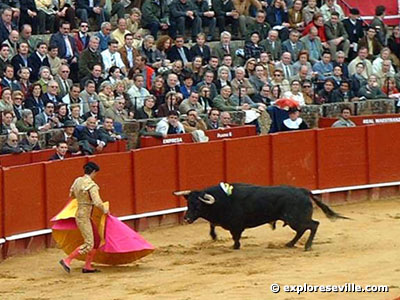
the first tercio involves the torero using
the purple and yellow cape, or capote. A portion
of this first part is dedicated to the picaderos,
two men on horseback who use a spear or lance which they
use to weaken the bull (essentially affecting the muscles
and tendons which keeps the bull from being able to raise
it's head easily in a dangerously high position). Thankfully
the horses wear protective gear!
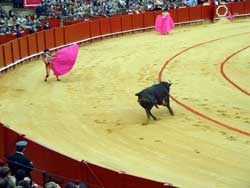
 The
second part is called the suerte de banderillas in which the banderilleros have the challenge of
sticking flags in the bulls back as he is charging them.
There are three banderilleros, each required to
stick two flags into the bull. The final phase is the known
as the suerte suprema, in which the torero makes use of what we are accustomed to seeing
- a red cape, or muleta. After showing off his
skills, passion and dominance of the bull he must face the
bull down and kill it with his sword as it charges towards
him. A quick kill is a sign of true skill while several
attempts means the torero loses the praise of the
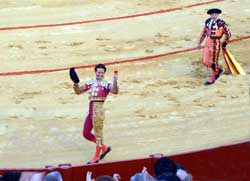
crowd. If the torero does well he may be awarded
the ear of the bull, which he may throw to the crowd. The
person sitting in front of me caught it one time and wrapped
it up to take home - who knows what they did with it! The
second part is called the suerte de banderillas in which the banderilleros have the challenge of
sticking flags in the bulls back as he is charging them.
There are three banderilleros, each required to
stick two flags into the bull. The final phase is the known
as the suerte suprema, in which the torero makes use of what we are accustomed to seeing
- a red cape, or muleta. After showing off his
skills, passion and dominance of the bull he must face the
bull down and kill it with his sword as it charges towards
him. A quick kill is a sign of true skill while several
attempts means the torero loses the praise of the
crowd. If the torero does well he may be awarded
the ear of the bull, which he may throw to the crowd. The
person sitting in front of me caught it one time and wrapped
it up to take home - who knows what they did with it!
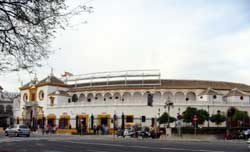 The
Plaza de Toros de la Maestranza was constructed over the
late-17th and 18th centuries and is one of the most famous
venues in all of Spain to take in a bullfight. On a side
note: before the construction of the Plaza de Toros corridas In Sevilla were held in the Plaza de San Francisco which
was specially prepared for the events. Located on the Paseo
de Colon, in the center and alongside the river Guadalquivir,
it's hard to miss The Plaza de Toros with it's baroque facade,
painted white with yellow trim. The ring is oval in shape
rather than a perfect circle, a detail which can be seen
well from the Giralda. In the beginning of the 20th century
the Plaza de Toros was renovated by architect Aníbal
Gonzalez, who is perhaps best know for his design of the
Plaza de España. Gonzalez also added several of the
buildings around the main structure including the Museo
de la Real Maestranza de Sevilla, the chapel or capilla, as well as the social quarters for the Real Maestranza
de Caballería. The Museum holds a number of posters,
clothing and other items related to bullfighting in the
city of Sevilla. Included among the exhibits is a cape painted
by Picasso. The
Plaza de Toros de la Maestranza was constructed over the
late-17th and 18th centuries and is one of the most famous
venues in all of Spain to take in a bullfight. On a side
note: before the construction of the Plaza de Toros corridas In Sevilla were held in the Plaza de San Francisco which
was specially prepared for the events. Located on the Paseo
de Colon, in the center and alongside the river Guadalquivir,
it's hard to miss The Plaza de Toros with it's baroque facade,
painted white with yellow trim. The ring is oval in shape
rather than a perfect circle, a detail which can be seen
well from the Giralda. In the beginning of the 20th century
the Plaza de Toros was renovated by architect Aníbal
Gonzalez, who is perhaps best know for his design of the
Plaza de España. Gonzalez also added several of the
buildings around the main structure including the Museo
de la Real Maestranza de Sevilla, the chapel or capilla, as well as the social quarters for the Real Maestranza
de Caballería. The Museum holds a number of posters,
clothing and other items related to bullfighting in the
city of Sevilla. Included among the exhibits is a cape painted
by Picasso.
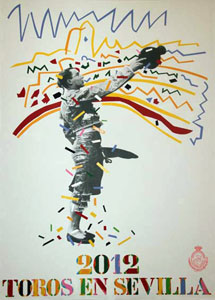 The
2012 schedule has been posted below. Bullfights
begin with the end of Semana Santa on the Domingo de
Resurección, which generally falls in April. From that Sunday (2012 it will be April 8th) through the Feria de Abril you
can see a bullfight almost every day with the exception of a few days at the beginning. After the Feria there are
less frequent corridas with the season practically
ending around July, with the exception of mid-August and September
when there are few bullfights leading up to the Feria de San Miguel.
Generally there is one event to be decided on October 12th. This is the
official schedule, and each year a few additional events
pop up on the calendar. Examples from last year were a few
weekends in July (novilladas) and in early September. Tickets can be purchased
at the Plaza de Toros itself or in some of the ventas for events in the city one of which is located on Calle
Tetuan in the main shopping district. Seats are divided
into sombra, or shade which is the best option; sol, or sun which worst option where you will sweat
while staring into the sun; or sol y sombra (sun
and shade - you get a bit of both as the sun moves and this
is a good middle ground. Prices will depend on your decision,
the toreros and whether it is an actual corrida de toros (the big bulls and hence the better toreros) or
a novillada (smaller bulls with less experienced toreros). The
2012 schedule has been posted below. Bullfights
begin with the end of Semana Santa on the Domingo de
Resurección, which generally falls in April. From that Sunday (2012 it will be April 8th) through the Feria de Abril you
can see a bullfight almost every day with the exception of a few days at the beginning. After the Feria there are
less frequent corridas with the season practically
ending around July, with the exception of mid-August and September
when there are few bullfights leading up to the Feria de San Miguel.
Generally there is one event to be decided on October 12th. This is the
official schedule, and each year a few additional events
pop up on the calendar. Examples from last year were a few
weekends in July (novilladas) and in early September. Tickets can be purchased
at the Plaza de Toros itself or in some of the ventas for events in the city one of which is located on Calle
Tetuan in the main shopping district. Seats are divided
into sombra, or shade which is the best option; sol, or sun which worst option where you will sweat
while staring into the sun; or sol y sombra (sun
and shade - you get a bit of both as the sun moves and this
is a good middle ground. Prices will depend on your decision,
the toreros and whether it is an actual corrida de toros (the big bulls and hence the better toreros) or
a novillada (smaller bulls with less experienced toreros).
Below is the 2012 schedule:
| 2012 |
Day |
Bullfighters / Toreros |
Type (Ganadería) |
8 April |
Sunday
|
Domingo de Resurreccion: Morante de la Puebla, José María Manzanares and Daniel Luque
|
Corrida de Toros
(Juan Pedro Domecq) |
13 April |
Friday
|
Javier Jiménez, Fernando Adrián and Gonzalo Caballero |
Corrida de Toros
(Fuente Ymbro) |
14
April |
Saturday |
Oliva Soto, Antonio Nazaré and Diego Silveti |
Corrida de Toros
(Montealto) |
15
April |
Sunday |
Andy Cartagena, Diego Ventura and Leonardo Hernández |
.
Corrida de Toros
(San Mateo y San Pelayo) |
16
April |
Monday |
Salvador Cortés, Luis Bolívar and Joselito Adame |
Corrida de Toros
(Conde de la Maza) |
17
April |
Tuesday |
Antonio Barrera, Javier Castaño and Alberto Aguilar |
Corrida de Toros
(Cuadri) |
18
April |
Wednesday |
Salvador Cortés, Antonio Nazaré and Esaú Fernández |
Corrida de Toros
(Fuente Ymbro) |
19
April |
Thursday |
Diego Urdiales, Iván Fandiño and Jiménez Fortes |
Corrida de Toros
(El Ventorrillo) |
20 April |
Friday |
Juan José Padilla, José María Manzanares and Alejandro Talavante |
Corrida de Toros
(Victoriano del Río) |
21 April |
Saturday |
El Fandi, Morante de la Puebla and Sebastián Castella |
Corrida de Toros
(Garcigrande) |
22 April |
Sunday |
Francisco Rivera Ordóñez, El Cid and El Fandi |
Corrida de Toros
(Torrehandilla) |
23 April |
Monday |
Feria:
Sebastián Castella, Daniel Luque and Cayetano Rivera Ordóñez |
Corrida de Toros
(Daniel Ruiz) |
24 April |
Tuesday |
Feria:
Iván Fandiño and David Mora |
Corrida de Toros
(Victorino Martín) |
25 April |
Wednesday |
Feria:
El Cid, Sebastián Castella and Alejandro Talavante
|
Corrida de Toros
(Jandilla - Vegahermosa) |
26 April |
Thursday |
Feria:
Morante de la Puebla, José María Manzanares and López Simón
|
Corrida de Toros
(Núñez del Cuvillo) |
27 April |
Friday |
Feria:
El Cid, David Mora and Daniel Luque |
Corrida de Toros
(El Pilar) |
28 April |
Saturday |
Feria:
El Cordobés, Juan José Padilla and El Fandi |
Corrida de Toros
(Torrestrella) |
29 April |
Sunday
(Morning)
|
Feria:
Rui Fernandes, Diego Ventura, Joao Moura hijo, Francisco Palha, and Noelia Mota. |
Rejones
(Fermín Bohórquez) |
29 April |
Sunday
(Afternoon)
|
Feria:
José Luis Moreno, Rafaelillo and Serafín Marín |
Corrida de Toros
(Miura) |
13
May |
Sunday
|
Miguel Hidalgo, Ángel Jiménez and Tomás Angulo |
Novillada con Picadores
(Herederos de Salvador Guardiola) |
20
May |
Sunday
|
Conchi Ríos, Emilio Huertas and Álvaro Sanlúcar |
Novillada con Picadores
(El Serrano) |
7 Jun |
Thursday
|
Corrida del Corpus:
Sergio Flores, Rafael Cerro and Juan Ortega |
Novillada con Picadores
(Montealto) |
14 or 15 Aug |
Sunday
|
Corrida de la Virgen de los Reyes:
TBD |
Corrida de Toros |
21
Sep |
Friday
|
Feria de San Miguel:
Triunfadores de la temporada |
Novillada
(Juan Pedro Domecq) |
22
Sep |
Saturday
|
Feria de San Miguel:
El Cid, Sebastián Castella and Daniel Luque |
Corrida de Toros
(Juan Pedro Domecq y Núñez del Cuvillo) |
23
Sep |
Sunday
|
Feria de San Miguel:
José María Manzanares and Alejandro Talavante |
Corrida de Toros
(Juan Pedro Domecq and Núñez del Cuvillo) |
12
Oct |
Friday
|
TBD |
Corrida de Toros |
|